About Course
Medical Coding Course Description
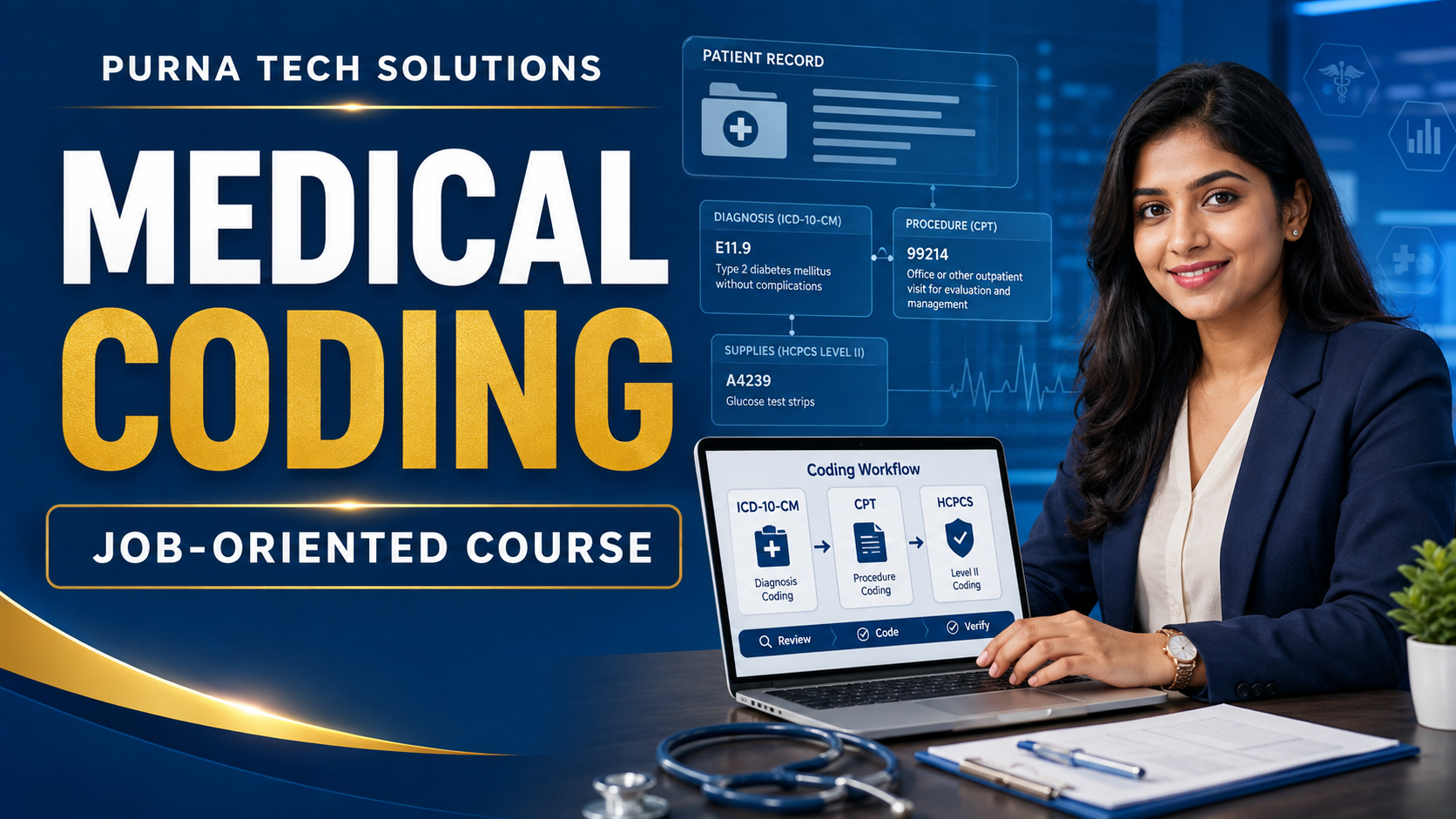
The Medical Coding – Complete Job-Oriented Program is a structured beginner-to-job-ready course designed to prepare students for careers in the healthcare and medical coding industry.
The course contains 10 comprehensive modules and 118 lessons, covering Medical Terminology, Human Anatomy and Physiology, ICD-10-CM, CPT, HCPCS Level II, Medical Billing, Real-Time Coding Practice, CPC Certification Preparation, and Job Preparation.
Students will learn how to read healthcare documentation, identify diagnoses and procedures, assign accurate medical codes, apply appropriate modifiers, understand claim forms, identify coding errors, and complete real-time medical coding cases.
Course Content
Module 1: Introduction to Medical Coding
This module introduces students to the healthcare industry and the fundamentals of medical coding. Students will understand how healthcare information is converted into standardized codes, the difference between coding and billing, professional responsibilities, certification pathways, and career opportunities.
-
Lesson 1: Introduction to the Healthcare Industry
-
Lesson 2: What Is Medical Coding?
-
Lesson 3: Medical Coding vs Medical Billing
-
Lesson 4: Role and Responsibilities of a Medical Coder
-
Lesson 5: Types of Medical Codes
-
Lesson 6: Medical Coding Work Environment
-
Lesson 7: Medical Coding Certifications
-
Lesson 8: Medical Coding Career Opportunities
Module 2: Medical Terminology
This module develops the medical vocabulary required to understand physician documentation, diagnoses, symptoms, diseases, procedures, investigations, and treatments. Students will learn to interpret medical terms by analysing their prefixes, suffixes, roots, and combining forms.
-
Lesson 1: Introduction to Medical Terminology
-
Lesson 2: Structure of Medical Words
-
Lesson 3: Common Medical Prefixes
-
Lesson 4: Common Medical Suffixes
-
Lesson 5: Common Medical Root Words
-
Lesson 6: Singular and Plural Medical Terms
-
Lesson 7: Medical Abbreviations and Symbols
-
Lesson 8: Diagnostic and Procedural Terminology
-
Lesson 9: Directional and Positional Terms
-
Lesson 10: Medical Terminology Practice
Module 3: Human Anatomy and Physiology
This module covers the structure, function, common diseases, diagnostic procedures, and treatments associated with the major human body systems. It builds the anatomical knowledge required for accurate diagnosis and procedure coding.
-
Lesson 1: Introduction to Anatomy and Physiology
-
Lesson 2: Integumentary System
-
Lesson 3: Musculoskeletal System
-
Lesson 4: Cardiovascular System
-
Lesson 5: Respiratory System
-
Lesson 6: Digestive System
-
Lesson 7: Urinary System
-
Lesson 8: Reproductive System
-
Lesson 9: Endocrine System
-
Lesson 10: Nervous System
-
Lesson 11: Special Senses
-
Lesson 12: Hemic, Lymphatic and Immune Systems
Module 4: ICD-10-CM Diagnosis Coding
This module teaches students how to assign accurate ICD-10-CM diagnosis codes using official conventions, guidelines, tabular instructions, and patient documentation.
-
Lesson 1: Introduction to ICD-10-CM
-
Lesson 2: ICD-10-CM Code Structure
-
Lesson 3: Alphabetic Index and Tabular List
-
Lesson 4: ICD-10-CM Conventions
-
Lesson 5: General ICD-10-CM Coding Guidelines
-
Lesson 6: Infectious and Parasitic Diseases
-
Lesson 7: Neoplasms
-
Lesson 8: Blood and Immune Disorders
-
Lesson 9: Endocrine and Metabolic Disorders
-
Lesson 10: Mental and Behavioural Disorders
-
Lesson 11: Nervous System and Sense Organ Disorders
-
Lesson 12: Circulatory System Disorders
-
Lesson 13: Respiratory System Disorders
-
Lesson 14: Digestive and Genitourinary Disorders
-
Lesson 15: Pregnancy and Childbirth Coding
-
Lesson 16: Injury, Poisoning and External Causes
-
Lesson 17: Symptoms, Signs and Abnormal Findings
-
Lesson 18: Z Codes and External Cause Codes
-
Lesson 19: ICD-10-CM Coding Scenarios
Module 5: CPT Procedure Coding
This module teaches the Current Procedural Terminology coding system used for physician services, outpatient procedures, diagnostic tests, and medical services.
-
Lesson 1: Introduction to CPT Coding
-
Lesson 2: CPT Code Book Guidelines and Symbols
-
Lesson 3: Evaluation and Management Services
-
Lesson 4: Office and Outpatient E/M Coding
-
Lesson 5: Anesthesia Coding
-
Lesson 6: Surgery – Integumentary System
-
Lesson 7: Surgery – Musculoskeletal System
-
Lesson 8: Surgery – Cardiovascular System
-
Lesson 9: Surgery – Respiratory and Digestive Systems
-
Lesson 10: Surgery – Urinary and Reproductive Systems
-
Lesson 11: Surgery – Nervous System and Special Senses
-
Lesson 12: Radiology Coding
-
Lesson 13: Pathology and Laboratory Coding
-
Lesson 14: Medicine Section Coding
-
Lesson 15: CPT Modifiers
-
Lesson 16: National Correct Coding Initiative Basics
-
Lesson 17: CPT Coding Scenarios
Module 6: HCPCS Level II Coding
This module introduces HCPCS Level II coding for medical supplies, drugs, ambulance services, durable medical equipment, and services not included in CPT.
-
Lesson 1: Introduction to HCPCS Level II
-
Lesson 2: HCPCS Code Categories
-
Lesson 3: Durable Medical Equipment Coding
-
Lesson 4: Drugs and Biologicals
-
Lesson 5: Medical Supplies and Prosthetics
-
Lesson 6: Ambulance and Transportation Services
-
Lesson 7: HCPCS Modifiers
-
Lesson 8: HCPCS Coding Practice
Module 7: Medical Billing Basics
This module explains how coded information is converted into healthcare claims and how those claims move through the reimbursement cycle.
-
Lesson 1: Introduction to Medical Billing
-
Lesson 2: Healthcare Revenue Cycle Management
-
Lesson 3: Types of Health Insurance Plans
-
Lesson 4: Patient Registration and Insurance Verification
-
Lesson 5: CMS-1500 Claim Form
-
Lesson 6: UB-04 Claim Form
-
Lesson 7: Claim Submission and Adjudication
-
Lesson 8: Claim Denials and Rejections
-
Lesson 9: Explanation of Benefits
-
Lesson 10: Appeals and Follow-Up
Module 8: Real-Time Practical Medical Coding
This module builds job-ready coding skills through realistic clinical documentation, coding scenarios, claim analysis, error identification, and quality review.
-
Lesson 1: Understanding Medical Records
-
Lesson 2: Physician Documentation Review
-
Lesson 3: Outpatient Coding Cases
-
Lesson 4: Emergency Department Coding Cases
-
Lesson 5: Surgery and Operative Report Coding
-
Lesson 6: Radiology and Laboratory Coding Cases
-
Lesson 7: Multispecialty Coding Cases
-
Lesson 8: Coding Errors and Corrections
-
Lesson 9: Coding Audits and Quality Review
-
Lesson 10: Productivity and Accuracy Standards
-
Lesson 11: Encoder and Coding Software Awareness
-
Lesson 12: Complete Medical Coding Practice Cases
Module 9: CPC Certification Preparation
This module prepares students for certification-style medical coding examinations through guideline revision, timed practice, case analysis, and mock examinations.
-
Lesson 1: Introduction to the CPC Examination
-
Lesson 2: CPT Guideline Revision
-
Lesson 3: ICD-10-CM Guideline Revision
-
Lesson 4: HCPCS and Modifier Revision
-
Lesson 5: Medical Terminology and Anatomy Revision
-
Lesson 6: Compliance and Regulatory Basics
-
Lesson 7: Certification Question-Solving Techniques
-
Lesson 8: Section-Wise Practice Test
-
Lesson 9: CPC Mock Test 1
-
Lesson 10: CPC Mock Test 2
-
Lesson 11: Final Revision Strategy
Module 10: Job Preparation and Final Assessment
This module prepares students for medical coding employment through resume development, interview practice, professional communication, mock assessments, and final evaluation.
-
Lesson 1: Medical Coding Job Roles
-
Lesson 2: Building a Medical Coding Resume
-
Lesson 3: Medical Coding Interview Questions
-
Lesson 4: HR Interview Preparation
-
Lesson 5: Professional Communication Skills
-
Lesson 6: Coding Assessment Preparation
-
Lesson 7: Mock Technical Interview
-
Lesson 8: Mock HR Interview
-
Lesson 9: Final Practical Project
-
Lesson 10: Final Course Assessment
-
Lesson 11: Certification and Career Roadmap
Student Ratings & Reviews

No Review Yet