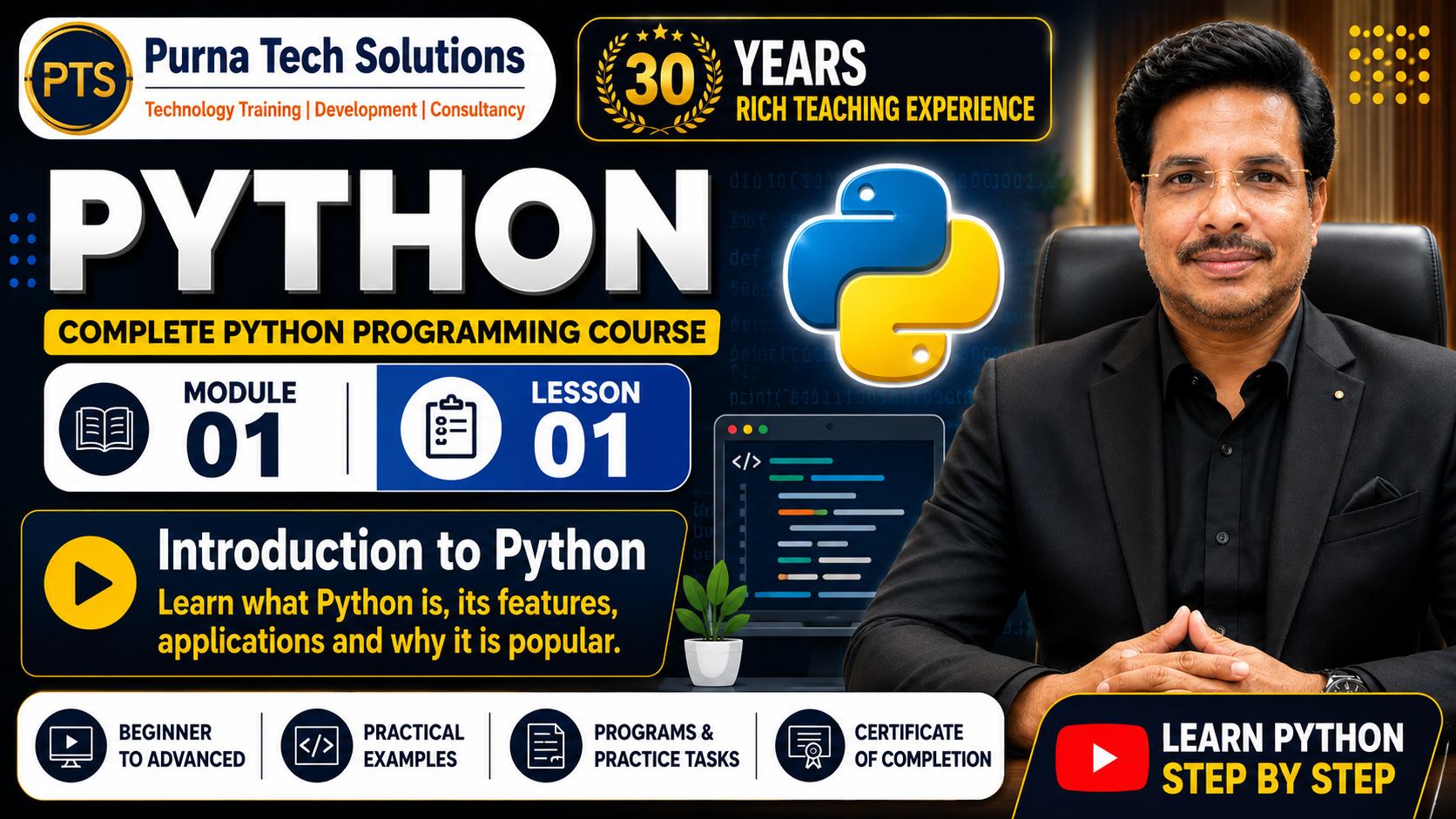
About Course
Learn Python programming from basics with practical examples and hands-on exercises. This course covers Python fundamentals, variables, data types, operators, conditional statements, loops, functions and more. Designed for beginners who want to build a strong foundation in Python programming.
What Will You Learn?
- Understand Python programming from basics to advanced concepts
- Write clean and efficient Python programs
- Work with variables, data types, operators and control statements
- Use functions, modules and packages effectively
- Master strings, lists, tuples, sets and dictionaries
- Understand Object-Oriented Programming in Python
- Handle files, exceptions and errors
- Work with regular expressions and useful Python libraries
- Solve practical programming problems and coding exercises
- Build real-world Python projects
- Prepare for Python programming interviews and assessments
Course Content
Module 1: Introduction to Python
Learn the fundamentals of Python programming, its features, applications, installation process, and how to write your first Python program.
-
Lesson 1: What is Python?
00:10 -
Lesson 2: Features of Python
00:10 -
Lesson 3: Installing Python & VS Code
00:10 -
Lesson 4: Your First Python Program
00:10 -
Lesson 5: Python Syntax, Comments & Indentation
Module 2: Variables & Data Types
Learn how Python stores and manages data using variables, identifiers, built-in data types, dynamic typing, type checking, and practical examples.
-
Lesson 6: Introduction to Variables
-
Lesson 7: Rules for Naming Variables
-
Lesson 8: Multiple Assignment
-
Lesson 9: Python Data Types
-
Lesson 10: Checking Data Types with type()
-
Lesson 11: Dynamic Typing in Python
Module 3: Python Operators
Learn the different types of operators in Python including arithmetic, assignment, comparison, logical, identity, membership, and bitwise operators with practical examples.
-
Lesson 12: Arithmetic Operators
-
Lesson 13: Assignment Operators
-
Lesson 14: Comparison Operators
-
Lesson 15: Logical Operators
-
Lesson 16: Identity and Membership Operators
-
Lesson 17: Bitwise Operators
-
Lesson 18: Operator Precedence and Associativity
Module 4: Input, Output & Type Conversion
Learn how to accept user input, display formatted output, convert data between different types, and work with Python's built-in input, output, and type conversion functions.
-
Lesson 19: Taking User Input with input()
-
Lesson 20: Displaying Output with print()
-
Lesson 21: Type Conversion and Type Casting
-
Lesson 22: Formatted Output Using f-Strings
-
Lesson 23: String Formatting with format()
-
Lesson 24: Practical Programs Using Input and Output
Module 5: Conditional Statements
Learn how to control the flow of Python programs using conditional statements such as if, if-else, if-elif-else, nested conditions, and conditional expressions with practical programs.
-
Lesson 25: Introduction to Conditional Statements
-
Lesson 26: The if Statement
-
Lesson 27: The if-else Statement
-
Lesson 28: The if-elif-else Statement
-
Lesson 29: Nested if Statements
-
Lesson 30: Conditional Expressions – Ternary Operator
-
Lesson 31: Conditional Statements – Practical Programs
Module 6: Loops in Python
Learn how to repeat tasks efficiently in Python using while and for loops, range(), nested loops, loop control statements, and practical looping programs.
-
Lesson 32: Introduction to Loops
-
Lesson 33: The while Loop
-
Lesson 34: The for Loop
-
Lesson 35: The range() Function
-
Lesson 36: Nested Loops
-
Lesson 37: break Statement
-
Lesson 38: continue and pass Statements
-
Lesson 39: else with Loops
-
Lesson 40: Loops – Practical Programs and Patterns
Module 7: Strings in Python
Learn how to create, access, manipulate, format, search, and process text data in Python using string indexing, slicing, operators, methods, escape sequences, and practical programs.
-
Lesson 41: Introduction to Strings
-
Lesson 42: String Indexing
-
Lesson 43: String Slicing
-
Lesson 44: String Operators
-
Lesson 45: Important String Methods
-
Lesson 46: Searching and Replacing in Strings
-
Lesson 47: Splitting and Joining Strings
-
Lesson 48: String Testing and Validation Methods
-
Lesson 49: Escape Sequences and String Formatting
-
Lesson 50: String Practical and Interview Programs
Module 8: Lists in Python
Learn how to create, access, modify, organize, and process collections of data using Python lists, including indexing, slicing, list methods, nested lists, comprehensions, and practical programs.
-
Lesson 51: Introduction to Lists
-
Lesson 52: Accessing List Elements – Indexing
-
Lesson 53: List Slicing
-
Lesson 54: Adding Elements to a List
-
Lesson 55: Updating and Removing List Elements
-
Lesson 56: Important List Methods and Operations
-
Lesson 57: Sorting and Reversing Lists
-
Lesson 58: Nested Lists and Two-Dimensional Data
-
Lesson 59: List Comprehension
-
Lesson 60: List Practical and Interview Programs
Module 9: Tuples in Python
Learn how to create, access, manipulate, and work with tuples in Python. This module covers tuple operations, methods, packing, unpacking, and practical applications.
-
Lesson 1: Introduction to Tuples
-
Lesson 2: Creating and Accessing Tuples
-
Lesson 3: Tuple Operations and Methods
-
Lesson 4: Tuple Packing and Unpacking
-
Lesson 5: Practical Programs Using Tuples
Module 10: Sets in Python
Learn how to create and work with sets in Python. This module covers set properties, operations, methods, and practical applications for handling unique and unordered data.
-
Lesson 1: Introduction to Sets
-
Lesson 2: Creating and Accessing Sets
-
Lesson 3: Set Methods in Python
-
Lesson 4: Set Operations
-
Lesson 5: Practical Programs Using Sets
Module 11: Dictionaries in Python
Learn how to create, access, modify, and manage dictionaries in Python. This module covers key-value pairs, dictionary methods, operations, and practical applications for storing and processing structured data.
-
Lesson 1: Introduction to Dictionaries
-
Lesson 2: Creating and Accessing Dictionaries
-
Lesson 3: Adding, Updating and Removing Dictionary Items
-
Lesson 4: Dictionary Methods and Operations
-
Lesson 5: Practical Programs Using Dictionaries
Module 12: Functions in Python
Learn how to create and use functions in Python to organize code, improve reusability, and simplify complex programs. This module covers function creation, parameters, arguments, return values, and different types of arguments.
-
Lesson 1: Introduction to Functions
-
Lesson 2: Creating and Calling Functions
-
Lesson 3: Function Parameters and Arguments
-
Lesson 4: Return Values and Types of Arguments
-
Lesson 5: Practical Programs Using Functions
Module 13: Advanced Functions and Lambda Expressions
Explore advanced function concepts in Python including lambda expressions, recursion, scope of variables, and functional programming tools used for efficient data processing.
-
Lesson 1: Local and Global Variables
-
Lesson 2: Lambda Functions
-
Lesson 3: Map, Filter and Reduce Functions
-
Lesson 4: Recursive Functions
-
Lesson 5: Practical Programs Using Advanced Functions
Module 14: Modules and Packages in Python
Learn how to organize Python programs using modules and packages. This module covers built-in modules, user-defined modules, importing techniques, and creating reusable Python packages.
-
Lesson 1: Introduction to Modules
-
Lesson 2: Importing Modules in Python
-
Lesson 3: Built-in Python Modules
-
Lesson 4: Creating User-Defined Modules and Packages
-
Lesson 5: Practical Programs Using Modules
Module 15: Object-Oriented Programming – Introduction
Learn the fundamentals of Object-Oriented Programming (OOP) in Python. This module introduces classes, objects, constructors, instance variables, methods, and the foundation required for advanced OOP concepts.
-
Lesson 1: Introduction to Object-Oriented Programming
-
Lesson 2: Classes and Objects in Python
-
Lesson 3: Constructors and the __init__() Method
-
Lesson 4: Instance Variables and Methods
-
Lesson 5: Practical Programs Using Classes and Objects
Module 16: Object-Oriented Programming – Advanced Concepts
Explore advanced Object-Oriented Programming concepts in Python. This module covers inheritance, method overriding, polymorphism, encapsulation, and abstraction to build structured and reusable applications.
-
Lesson 1: Inheritance in Python
-
Lesson 2: Types of Inheritance
-
Lesson 3: Method Overriding and Polymorphism
-
Lesson 4: Encapsulation and Abstraction
-
Lesson 5: Practical Programs Using Advanced OOP
Module 17: Exception Handling in Python
Learn how to identify and handle runtime errors using Python's exception handling mechanism. This module covers try-except blocks, multiple exceptions, finally, raise, and user-defined exceptions.
-
Lesson 1: Introduction to Errors and Exceptions
-
Lesson 2: Try and Except Blocks
-
Lesson 3: Multiple Except Blocks and Else
-
Lesson 4: Finally, Raise and User-Defined Exceptions
-
Lesson 5: Practical Programs Using Exception Handling
Module 18: File Handling in Python
Learn how to create, read, write, append, and manage files using Python. This module covers file modes, text file operations, the with statement, and practical file-processing applications.
-
Lesson 1: Introduction to File Handling
-
Lesson 2: Opening and Reading Files
-
Lesson 3: Writing and Appending Data to Files
-
Lesson 4: Working with the with Statement and File Management
-
Lesson 5: Practical Programs Using File Handling
Module 19: Regular Expressions in Python
Learn how to search, match, extract, and validate text using Regular Expressions. This module introduces patterns, special characters, Python's re module, and real-world data validation.
-
Lesson 1: Introduction to Regular Expressions
-
Lesson 2: The re Module and Basic Functions
-
Lesson 3: Regex Metacharacters and Special Sequences
-
Lesson 4: Groups, Quantifiers and Pattern Matching
-
Lesson 5: Practical Regex Validation Programs
Module 20: Date, Time and Math Operations in Python
Learn how to work with dates, times, mathematical operations, and random values using Python's built-in modules. This module focuses on practical utilities frequently required in real-world applications.
-
Lesson 1: Working with Date and Time
-
Lesson 2: Date Formatting and Date Calculations
-
Lesson 3: Math Module in Python
-
Lesson 4: Random Module in Python
-
Lesson 5: Practical Programs Using Date, Time, Math and Random
Module 21: Comprehensions in Python
Learn how to write concise and efficient Python code using comprehensions. This module covers list, dictionary, and set comprehensions along with conditions and practical data-processing examples.
-
Lesson 1: Introduction to Comprehensions
-
Lesson 2: List Comprehensions
-
Lesson 3: Conditional List Comprehensions
-
Lesson 4: Dictionary and Set Comprehensions
-
Lesson 5: Practical Programs Using Comprehensions
Module 22: Iterators and Generators in Python
Understand Python's iterator and generator concepts for efficient data processing. This module covers iterable objects, iterators, iter(), next(), generator functions, and the yield keyword.
-
Lesson 1: Introduction to Iterables and Iterators
-
Lesson 2: Working with iter() and next()
-
Lesson 3: Creating Custom Iterators
-
Lesson 4: Generators and the yield Keyword
-
Lesson 5: Practical Programs Using Iterators and Generators
Module 23: Decorators in Python
Learn how decorators enhance the functionality of functions and methods without modifying their original code. This module covers nested functions, function arguments, decorators, and practical applications.
-
Lesson 1: Introduction to Decorators
-
Lesson 2: Nested Functions and Functions as Arguments
-
Lesson 3: Creating Your First Decorator
-
Lesson 4: Decorators with Arguments and Multiple Decorators
-
Lesson 5: Practical Applications of Decorators
Module 24: Multithreading in Python
Learn the fundamentals of multithreading and concurrent execution in Python. This module covers thread creation, the threading module, synchronization, and practical applications.
-
Lesson 1: Introduction to Multithreading
-
Lesson 2: Creating Threads in Python
-
Lesson 3: Thread Methods and Thread Lifecycle
-
Lesson 4: Thread Synchronization and Locks
-
Lesson 5: Practical Programs Using Multithreading
Module 25: Database Programming with Python and MySQL
Learn how to connect Python applications with MySQL databases. This module covers database connectivity, SQL execution, CRUD operations, transactions, and building simple database-driven applications.
-
Lesson 1: Introduction to Python Database Connectivity
-
Lesson 2: Connecting Python with MySQL
-
Lesson 3: Insert and Retrieve Database Records
-
Lesson 4: Update, Delete and Transaction Management
-
Lesson 5: Python MySQL Mini Project
Module 26: Working with CSV and JSON Files
Learn how to work with CSV and JSON data formats in Python. This module covers reading, writing, updating, and processing structured data commonly used in real-world applications.
-
Lesson 1: Introduction to CSV and JSON
-
Lesson 2: Reading and Writing CSV Files
-
Lesson 3: Working with JSON Data
-
Lesson 4: Converting and Processing Structured Data
-
Lesson 5: Practical Programs Using CSV and JSON
Module 27: NumPy Fundamentals
Learn the fundamentals of NumPy, one of the most important Python libraries for numerical computing. This module covers arrays, indexing, mathematical operations, and multidimensional data.
-
Lesson 1: Introduction to NumPy
-
Lesson 2: Creating NumPy Arrays
-
Lesson 3: Array Indexing and Slicing
-
Lesson 4: NumPy Array Operations
-
Lesson 5: Practical Programs Using NumPy
Module 28: Pandas Fundamentals
Learn how to analyze and manipulate structured data using the Pandas library. This module introduces Series, DataFrames, data selection, filtering, and basic data analysis.
-
Lesson 1: Introduction to Pandas
-
Lesson 2: Pandas Series and DataFrames
-
Lesson 3: Reading CSV and Excel Data
-
Lesson 4: Selecting, Filtering and Modifying Data
-
Lesson 5: Practical Data Analysis Using Pandas
Module 29: Data Visualization with Matplotlib
Learn how to visually represent data using Matplotlib. This module covers different chart types, customization, labels, legends, and practical data visualization techniques.
-
Lesson 1: Introduction to Data Visualization and Matplotlib
-
Lesson 2: Line and Bar Charts
-
Lesson 3: Pie Charts, Histograms and Scatter Plots
-
Lesson 4: Customizing Charts
-
Lesson 5: Practical Data Visualization Project
Module 30: GUI Application Development with Tkinter
Learn how to build desktop applications using Python's Tkinter library. This module covers windows, widgets, layouts, events, forms, and database-connected GUI applications.
-
Lesson 1: Introduction to Tkinter
-
Lesson 2: Tkinter Widgets
-
Lesson 3: Layout Management and Event Handling
-
Lesson 4: Forms and Database Connectivity
-
Lesson 5: Tkinter Mini Project
Module 31: Advanced Pandas and Data Analysis
Explore advanced data analysis techniques using Pandas. This module covers data cleaning, missing values, grouping, aggregation, merging, and practical analysis of real-world datasets.
-
Lesson 1: Data Cleaning with Pandas
-
Lesson 2: Sorting, Grouping and Aggregation
-
Lesson 3: Merging and Joining DataFrames
-
Lesson 4: Advanced Data Transformation
-
Lesson 5: Real-World Data Analysis Project
Module 32: Python Database Application Development
Apply Python and MySQL concepts to develop database-driven applications. This module focuses on application structure, CRUD operations, validation, search functionality, and project development.
-
Lesson 1: Planning a Database Application
-
Lesson 2: Building Insert and Display Operations
-
Lesson 3: Search and Update Operations
-
Lesson 4: Delete, Validation and Error Handling
-
Lesson 5: Database Application Mini Project
Module 33: Introduction to APIs and REST APIs
Understand how modern applications communicate through APIs. This module introduces APIs, REST architecture, HTTP methods, endpoints, status codes, and JSON-based communication.
-
Lesson 1: Introduction to APIs
-
Lesson 2: Understanding REST APIs
-
Lesson 3: HTTP Methods
-
Lesson 4: HTTP Status Codes and JSON Responses
-
Lesson 5: Exploring Public APIs
Module 34: Working with APIs Using Python
Learn how to connect Python applications with REST APIs, send HTTP requests, process JSON responses, use parameters, and handle API errors.
-
Lesson 1: Introduction to the Requests Library
-
Lesson 2: Sending GET Requests
-
Lesson 3: POST, PUT and DELETE Requests
-
Lesson 4: API Authentication and Error Handling
-
Lesson 5: API-Based Mini Project
Module 35: Web Scraping with Python
Learn how Python can extract publicly accessible information from web pages for legitimate data collection and analysis. This module covers HTML basics, Requests, Beautiful Soup, and structured data extraction.
-
Lesson 1: Introduction to Web Scraping
-
Lesson 2: Understanding HTML for Web Scraping
-
Lesson 3: Web Scraping with Beautiful Soup
-
Lesson 4: Extracting and Storing Web Data
-
Lesson 5: Web Scraping Mini Project
Module 36: Introduction to Flask
Learn the fundamentals of Flask, a lightweight Python web framework. This module introduces web applications, routes, templates, forms, and the basic Flask project structure.
-
Lesson 1: Introduction to Web Development and Flask
-
Lesson 2: Installing Flask and Creating the First Application
-
Lesson 3: Routes and URL Mapping
-
Lesson 4: HTML Templates with Flask
-
Lesson 5: Building a Simple Flask Website
Module 37: Flask Web Application Development
Build database-driven web applications using Flask. This module covers forms, templates, database integration, CRUD operations, authentication concepts, and practical project development.
-
Lesson 1: Working with Forms in Flask
-
Lesson 2: Flask and Database Connectivity
-
Lesson 3: CRUD Operations in Flask
-
Lesson 4: User Registration and Login Concepts
-
Lesson 5: Flask Mini Project
Module 38: Python Automation and Real-World Scripts
Learn how Python can automate repetitive tasks and improve productivity. This module covers file automation, Excel automation, email concepts, and practical automation scripts.
-
Lesson 1: Introduction to Python Automation
-
Lesson 2: File and Folder Automation
-
Lesson 3: Excel Automation with Python
-
Lesson 4: Email and Report Automation Concepts
-
Lesson 5: Practical Automation Projects
Module 39: Python Major Project
Apply the concepts learned throughout the course to design and develop a complete Python application. Students will learn project planning, development, testing, debugging, documentation, and presentation.
-
Lesson 1: Project Selection and Requirement Analysis
-
Lesson 2: Project Architecture and Database Design
-
Lesson 3: Project Development – Part 1
-
Lesson 4: Project Development – Part 2 and Testing
-
Lesson 5: Project Documentation and Presentation
Module 40: Python Interview Preparation and Final Assessment
Prepare for Python technical interviews and evaluate the knowledge gained throughout the course. This module covers interview questions, coding challenges, project explanation, mock interviews, and final assessment.
-
Lesson 1: Python Interview Questions – Basics
-
Lesson 2: Python Interview Questions – Advanced
-
Lesson 3: Python Coding Challenges
-
Lesson 4: Resume, Project Explanation and Mock Interview
-
Lesson 5: Final Assessment and Course Completion
Student Ratings & Reviews
5.0
Total 1 Rating
5
1 Rating
4
0 Rating
3
0 Rating
2
0 Rating
1
0 Rating
super